
From AI Inference to Machine Action: Designing the Industrial Connectivity Path
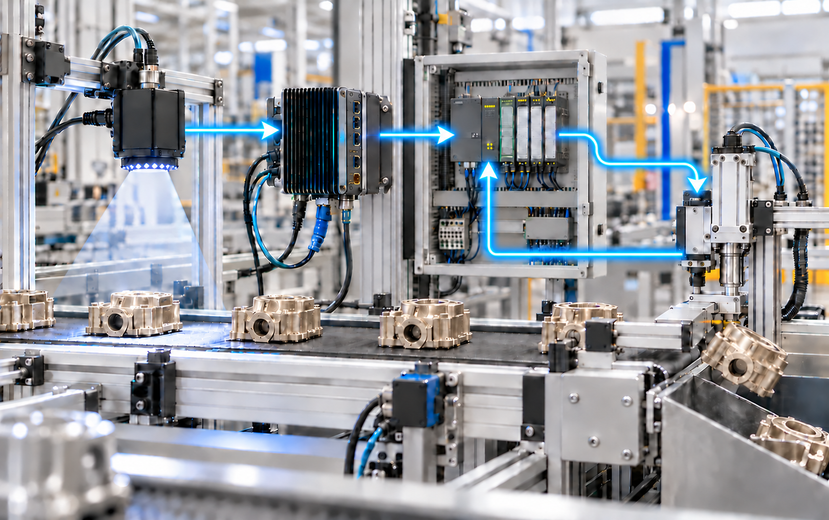
Industrial AI depends on a connectivity path that carries data from a physical event through AI processing to machine action. See how each stage shapes the next and what must be considered when designing the complete path.
Industrial AI Connectivity Snapshot
- Map before selecting. Define the full path before choosing interfaces.
- Design for actual conditions. Base connections on sustained workloads, timing, and the factory environment.
- Define control authority. Establish how AI inference informs the controller and which system authorizes machine action.
- Evaluate the full system. Check each design change for downstream effects.
AI inference is only one event in a longer communication path on the factory floor.
Consider a machine-vision inspection line. A camera captures an image of a product, and an edge AI system classifies it as acceptable or defective. A programmable logic controller (PLC) applies the machine’s control logic to that result. An acceptable part continues through the line, while a robot or reject mechanism removes a defective part.
Designing the end-to-end connectivity path starts by mapping each stage from image capture to machine response. That map defines the requirements for each stage and the connections between them before interfaces are selected.
How to Map the Industrial AI Connectivity Path Before Selecting Interfaces
Mapping starts by identifying the condition the AI system must detect on the production line and the data needed to represent it. The response deadline establishes the path’s timing requirements, while the systems involved establish the stages the path must connect.
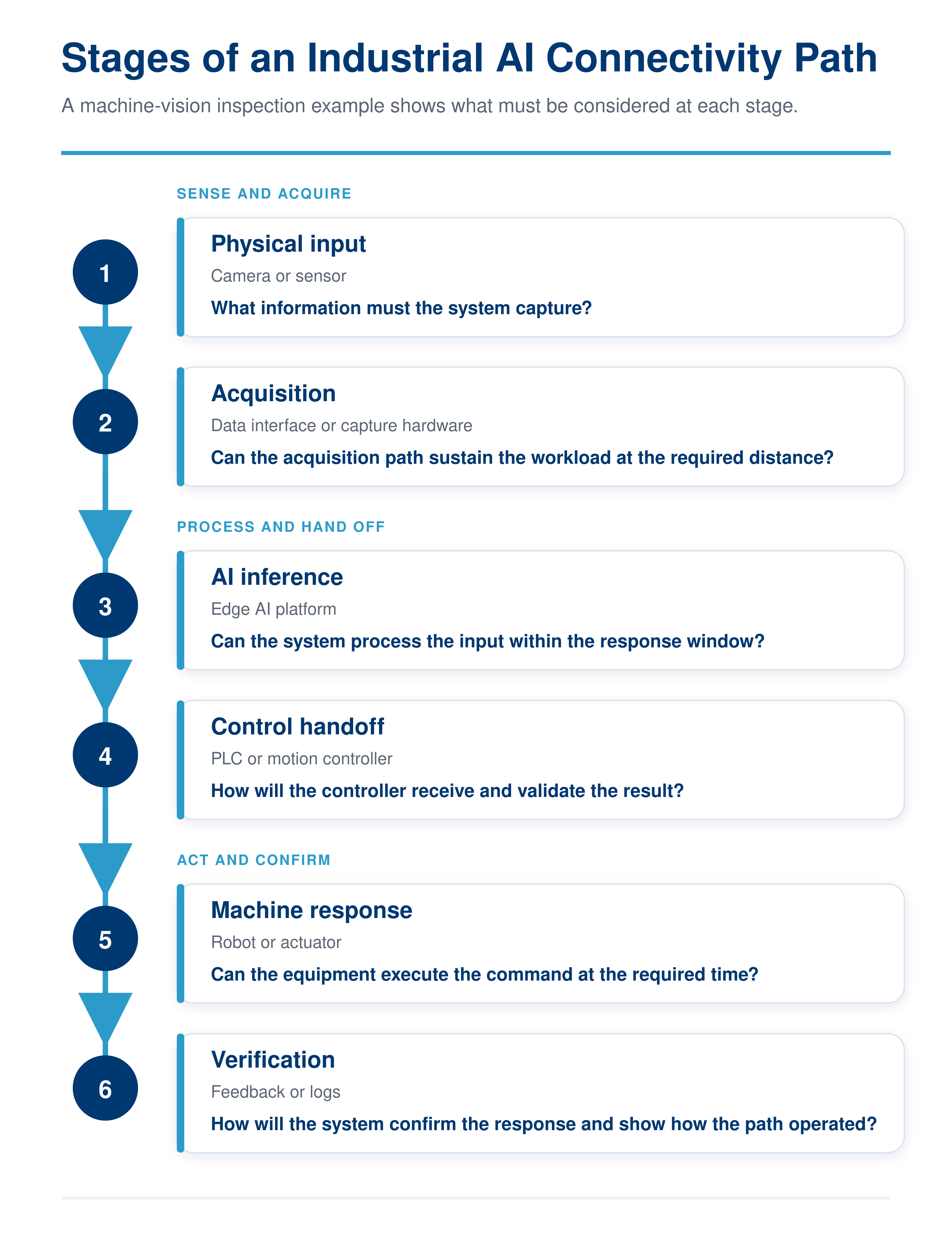
The industrial AI connectivity path starts when a physical event triggers data capture. The data moves to the AI platform, which sends its inference result to the controller. The controller applies the machine’s control logic and issues a command to the equipment responsible for the action.
The path ends when the equipment responds and the system confirms that the response occurred. Identifying these stages provides the framework for mapping the connections from one stage to the next before interfaces are selected.
How Each Stage Shapes the Industrial AI Connectivity Path
Once the stages are mapped, the next step is to consider how each one affects the connection that follows. The physical input shapes the data acquisition connection, while the inference result determines what the controller must receive. The required machine response determines when the controller’s command must arrive and what feedback is needed. Following these handoffs through the inspection example shows how the path functions as a connected system rather than a collection of individual interfaces.
Physical Input and Acquisition: Capturing the Event and Moving the Data
The physical input determines what the system must capture. In the machine-vision inspection example, a product reaching the inspection point triggers the camera to capture an image. The acquisition connection then carries that image data to the edge AI platform.
The amount of data that must move from the camera to the AI platform influences the interface choice. Higher resolution and frame rates increase throughput, while additional cameras increase the sustained load. The camera’s location then determines how that data is transferred. Ethernet supports distributed cameras over longer cable runs. USB connects nearby cameras directly, while PCIe provides internal expansion for dedicated capture hardware.
The acquisition interface must sustain the data load, and both devices need software support for the connection. The goal is to deliver the image data to the AI platform with enough time remaining for inference.
AI Inference and Control Handoff: Turning Data into a Usable Result
The edge AI platform analyzes the input and produces an inference result. The form of that result depends on the application. It may indicate pass or fail, report a measurement, or identify the location of a detected object.
Each type of result needs enough context for the controller to use it correctly. An identifier, such as a part or sequence number, links the inference result to the correct product moving through the line. Timing information shows whether the result arrived in time for the controller to act.
The handoff method depends partly on how much information the controller needs. Digital I/O is well suited when the result is a simple state, such as pass or fail. One or more electrical signals can communicate that state and indicate when it is valid.
A protocol-based exchange sends a structured message that can carry more detail. Ethernet, serial, or CAN bus can provide the connection. The AI platform and controller must use a common protocol and interpret the message consistently. If they cannot communicate directly, a gateway or translation software may be needed.
Once the result reaches the controller, the PLC applies the machine’s established control logic. The inference helps inform the controller’s decision, but the machine’s safety controls still determine whether the action can proceed.
Machine Response and Verification: Acting on and Confirming the Result
For the path to work as intended, the controller must issue its command early enough for the equipment to act. In the inspection example, the PLC tracks the defective part and signals the reject mechanism before the part passes the rejection point. The actuator then carries out the commanded response.
Verification closes the path. Feedback can confirm that the command was executed, while logs and synchronized timestamps show whether the result and response arrived on time. This information also makes the path easier to monitor after deployment.
The response and verification stages should therefore be considered when the path is first mapped. A fast AI inference is not enough if the controller, actuator, or feedback mechanism cannot complete its part within the application’s deadline.
Design Requirements That Span the Industrial AI Connectivity Path
Some requirements span several connections or the entire path rather than belonging to a single stage. Mapping helps reveal where those requirements apply and how a decision in one area can affect the stages that follow.
The response deadline belongs to the complete path, not just AI inference. Time is used as the system captures and transfers data, processes the input, hands the result to the controller, and carries out the machine response. Buffering or network traffic can add further delay. The end-to-end response time must remain within the application’s deadline across the full range of expected operating conditions. The speed of any single interface cannot determine the complete path’s response time on its own.
The design should allow technicians to monitor each stage and determine whether the path operated as intended. Connection status, communication counters, logs, and synchronized timestamps can reveal where data stopped or whether a result arrived too late.
Recovery capabilities should match the type of failure. A connection may recover automatically, while software or computer faults may require a restart or reset. The control strategy determines how the machine responds until valid results resume.
Factory conditions affect the path as well. Electrical noise can disrupt data, and vibration can loosen a cable. Heat or power disturbances may interrupt processing altogether. Isolation, high-retention connectors, thermal design, and power protection can help maintain the path, but each measure may affect cost, serviceability, or interface performance. These protections should therefore be considered during mapping rather than added after deployment.
Why the Industrial AI Connectivity Path Must Be Designed as One System
Mapping the complete path makes the dependencies between stages easier to see. A higher-resolution camera may increase the bandwidth requirement and the time needed to transfer and process each image. Replacing a controller could introduce a protocol mismatch, while changing an interface may affect cable distance or software support. Each change should prompt an end-to-end review so an improvement at one stage does not create a problem farther along the path.
An effective AI connectivity path relies on collaboration. The customer or system integrator defines the control strategy and safety requirements. Sealevel supports the hardware side of this work by integrating rugged edge computing with the industrial I/O, networking, and expansion required by the application. Connection protection and software support can then be matched to the conditions in which the path will operate.
Bringing those responsibilities together allows the team to evaluate the stages as one system and build a path around the application’s requirements.
Frequently Asked Questions
What is an industrial AI connectivity path?
An industrial AI connectivity path is the route data follows from a physical event through AI processing, control system handoff, machine response, and verification.
What stages make up an industrial AI connectivity path?
The stages are physical input, acquisition, AI inference, control handoff, machine response, and verification. Identifying them helps map the connections before interfaces are selected.
How do data volume and response time affect interface selection?
Data volume determines the sustained workload an interface must carry. Response time determines whether the complete path can process the data and complete the machine action before the application’s deadline.
How do interface and protocol compatibility affect an AI-to-controller handoff?
The interface provides the connection, while the protocol determines how the AI platform and controller exchange and interpret the result. Both systems must support a common protocol or use a gateway or translation software.
Why should an industrial AI connectivity path be designed as one system?
A decision at one stage can affect timing, compatibility, or performance elsewhere in the path. Evaluating the stages together helps prevent a decision at one stage from creating a problem farther along the path.
Categories: