
Workload Consolidation in Industrial Automation: Managing Complexity at the Edge
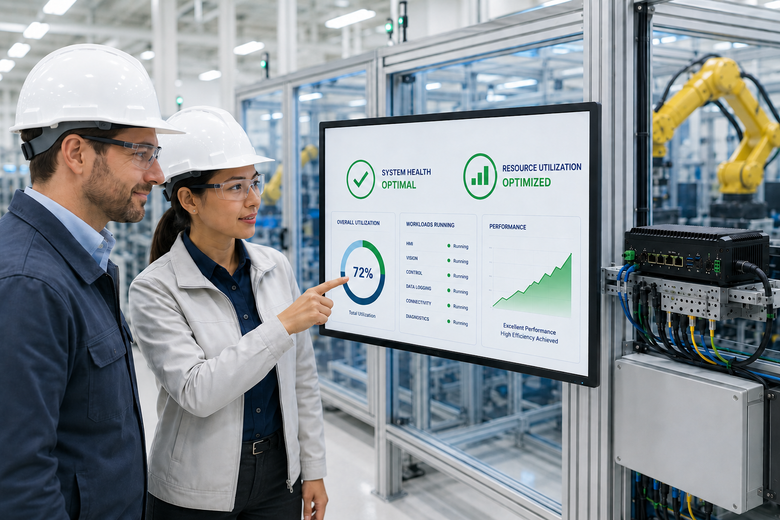
As industrial automation systems grow, adding another dedicated computer isn't always the best answer. Learn how workload consolidation organizes AI, HMI, control, diagnostics, and networking workloads on shared rugged embedded platforms to reduce architectural complexity while preserving workload isolation, long-term maintainability, and system performance.
Technical Snapshot
- Workload consolidation organizes related functions, such as control, machine vision, HMI, diagnostics, and connectivity, on a shared rugged embedded platform while preserving workload isolation.
- The primary benefit isn't simply fewer devices. It's better resource utilization and long-term maintainability by organizing workloads around operational requirements instead of assigning dedicated hardware.
- Consolidation starts with workload mapping and resource ownership before platform selection, evaluating each workload's processing, memory, timing, and I/O requirements.
- Defined workload boundaries simplify validation, updates, and future expansion, allowing industrial systems to accommodate new sensors, AI models, and connectivity over their lifecycle.
Walk the floor of a modern automation cell and you may find more hardware than the application needs. An industrial PC runs the human-machine interface (HMI). A separate vision computer processes camera frames for AI-based inspection. A gateway shuttles data to the plant network. Another device may handle logging and diagnostics.
Each one showed up for a good reason, adding a capability the application needed.
This is how some automation architectures grow at the edge: one function, one box, repeated until the system becomes a collection of dedicated computers connected through an increasingly complex architecture. It works. But every device added becomes another potential point of failure.
Workload consolidation is an architectural response to that sprawl. For system designers, the challenge is managing compute spread across an increasing number of discrete systems. Instead of determining where the next function should run, they're deciding which functions belong together and which should remain separate. Control, vision, and HMI may each operate as independent workloads, while diagnostics and connectivity maintain their own boundaries. That allows related functions to share a rugged embedded platform while preserving the separation each workload requires.
This approach to systems architecture reduces hardware, cabling, and complexity without sacrificing the separation industrial applications depend on.
Why Industrial Automation Architectures Become More Complex Over Time
It is common to find an industrial automation system where compute responsibilities are distributed across multiple dedicated platforms. One may host an AI inspection application, another may control remote connectivity, and others could support specialized processing or application-specific functions.
The setup is not inherently wrong. In fact, isolating a new function on dedicated hardware can simplify development, reduce risk, and avoid disrupting systems that are already working. The resulting arrangement often reflects years of incremental engineering decisions rather than a single architectural plan.
Eventually, the engineering burden shifts.
Managing the Architecture Instead of Expanding It
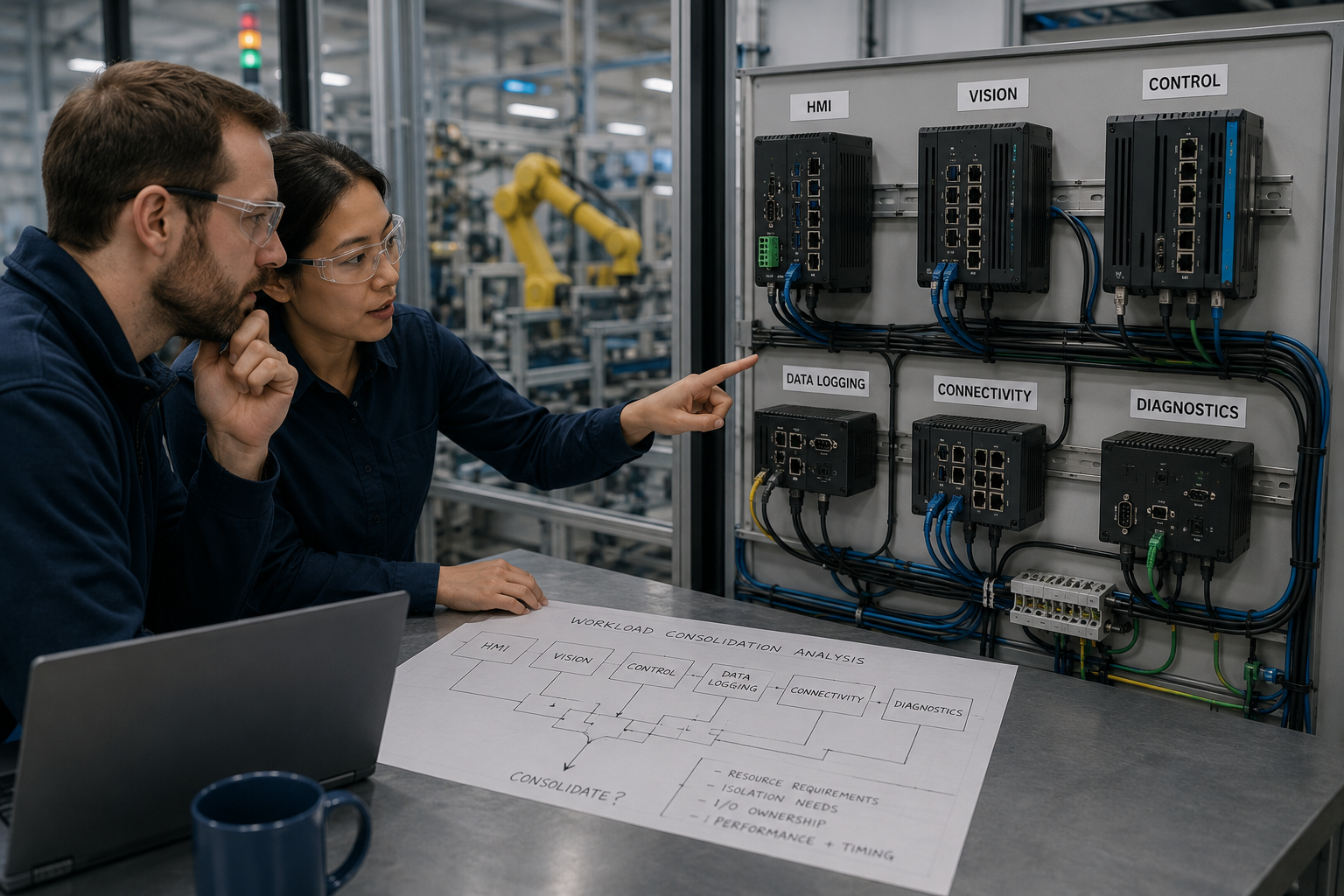
As capabilities accumulate, each dedicated system becomes part of the architecture engineers must integrate, validate, update, and support. Taken together, those decisions lead to a sprawling architecture that is increasingly distributed.
What began as a collection of purpose-built systems can become an application supported by numerous independent computing platforms, each with its own software, lifecycle, and maintenance requirements.
The underlying questions shift from whether or not each individual device serves a purpose, to whether or not the overall architecture still serves the application as efficiently as it could.
System designers must decide how computing resources should be organized. Rather than assigning every new capability to another computer, engineering teams evaluate how workloads relate to one another and whether the architecture can be simplified without compromising performance, reliability, or long-term support. That changes how embedded computing platforms are evaluated. The platform is no longer selected simply to support the next function. It's evaluated for its ability to organize workloads efficiently and remain maintainable as the application grows.
How Workload Consolidation Works in Industrial Automation
Workload consolidation doesn't mean running every application on one shared system or replacing every controller with a single computer. Both would recreate the same coordination problems the architecture was supposed to solve.
Instead, workload consolidation organizes related functions so they can operate on a shared embedded platform while preserving the behavior each was designed to deliver. The engineering work keeps those guarantees in place. Consolidation is the result of doing it well.
Consider an automated inspection cell. AI-based vision processing runs alongside the control logic that sequences the machine. An HMI gives operators a live view of both. A separate process handles diagnostics, watching I/O status and system health in the background. Each serves a different purpose, operates with different performance requirements, and may follow its own update cycle. They remain independent workloads even though they share the same underlying compute platform. The boundaries between them are defined by what each workload needs rather than by which box it happened to be assigned.
That separation is what makes workload consolidation practical. Rather than treating a shared platform as one large application, engineers define workload boundaries according to each function's needs.
Modern multicore processors, virtualization technologies, and workload partitioning make that approach possible. The end goal is an architecture that makes better use of available computing resources while remaining easier to integrate, validate, and support throughout the system's lifecycle.
Workload Mapping Comes Before Platform Selection
Workload consolidation begins by understanding the application’s requirements. An inspection workload that only needs to run periodically has different requirements than a control loop that must execute on a fixed schedule without exception.
Workload mapping begins by characterizing what each function requires: how much processing and memory it needs under peak load, whether it has timing constraints that can't be interrupted, what data it exchanges with other workloads, and how the system should respond if the workload becomes unavailable.
Getting mapping right is what determines whether workloads can safely share a platform. It's what keeps a consolidated architecture predictable rather than turning it into a new source of the same problems distributed hardware was meant to avoid.
Why Workload Consolidation Improves System Architecture
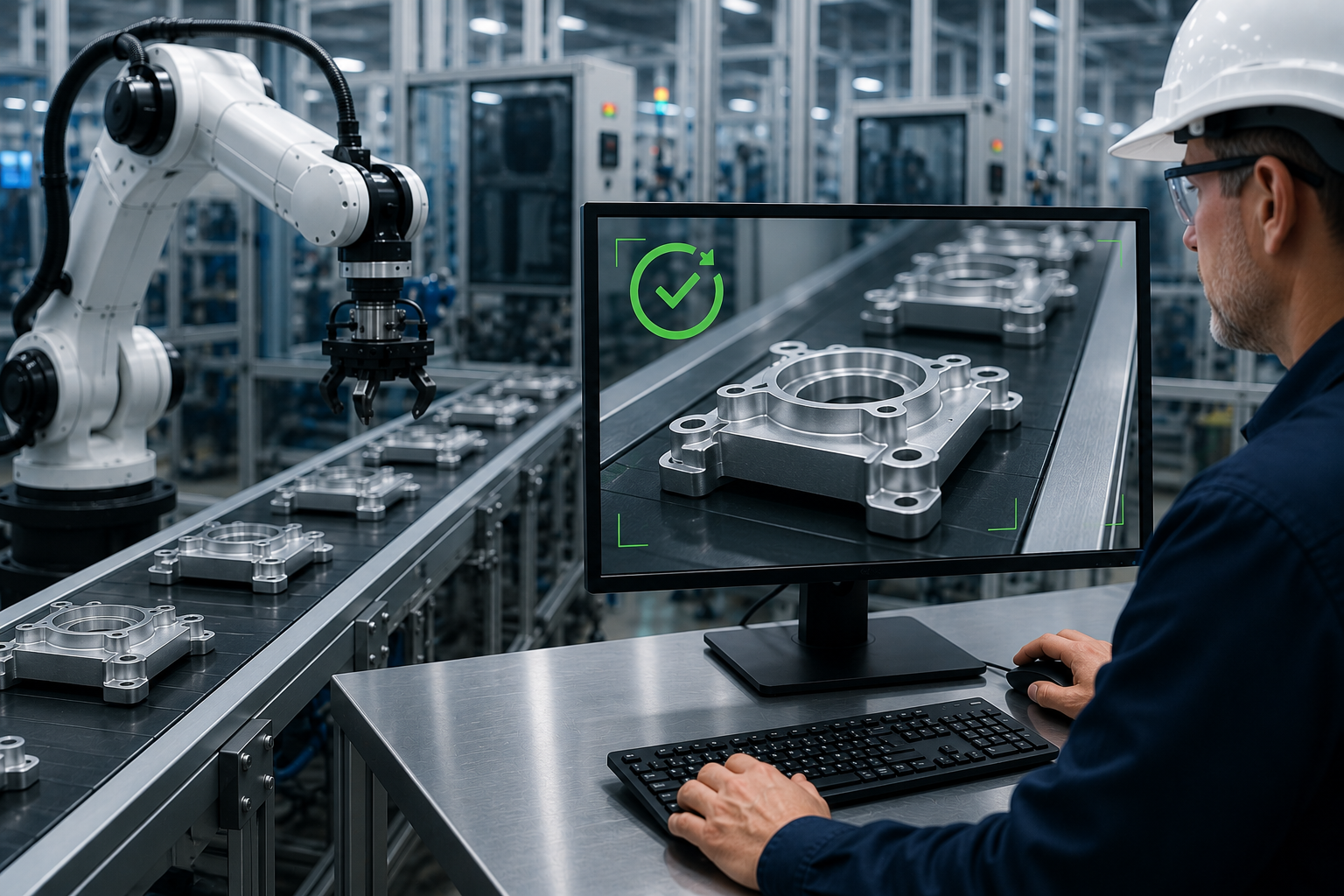
Reducing the number of computers in a system is the most visible outcome of workload consolidation. However, the greater benefit of workload consolidation is having an architecture organized around workload requirements instead of accumulated hardware.
Less wiring and fewer devices to integrate make a system easier to build. Long-term maintainability depends on how clearly workload boundaries were defined from the start.
As workloads are organized according to their operational requirements rather than assigned to dedicated hardware by default, resource utilization improves because computing resources can be matched more closely to workload requirements. Some functions require predictable execution, while others demand processing power only at specific points in the application.
Modern multicore embedded processors often have enough computing resources to support multiple workload domains. Organizing workloads around how they behave instead of where they run improves resource utilization, allowing a shared platform to make better use of available computing resources while preserving the boundaries each function depends on.
Workloads remain independent, but they communicate through defined interfaces instead of growing layers of software dependencies. Those boundaries make interactions easier to understand, validate, and maintain while limiting how far a problem in one workload can spread into another.
Workload Boundaries Support Long-Term Maintainability
The benefits continue over the course of a system's lifecycle. Software updates, operating system changes, and future compute upgrades can be planned around defined workload boundaries rather than a growing collection of independent platforms.
Those same architectural decisions also leave room for future capabilities. Adding another sensor, deploying an updated inference model, or expanding connectivity doesn't necessarily require redesigning the entire platform because the architecture was organized with growth in mind. The result is often fewer hardware nodes, fewer interconnects, and an architecture that's easier to integrate, support, and evolve as application requirements change.
When workload boundaries are built into the architecture from the start, updating one function or migrating to new compute doesn't require re-engineering the whole system. The boundaries that made consolidation safe on day one are the same ones that make it maintainable for years at the edge.
What Engineers Evaluate Before Consolidating Workloads
Once engineers begin evaluating workload consolidation, the more consequential decisions involve resource ownership.
Ownership is easy to overlook because it doesn't show up on a spec sheet. A control loop may require guaranteed access to processor time, memory, and the I/O it depends on. A vision workload needs clearly defined access to its resources. Sharing a platform doesn't eliminate resource ownership. It makes defining it even more important. Determining resource ownership before hardware is selected is what keeps the system predictable once it's running in the field.
That ownership question gets more complicated because workloads don't behave the same way. A control loop typically needs deterministic execution, where each operation completes within the same defined time window, cycle after cycle. A vision or AI workload behaves differently, sitting idle until a camera trigger fires, then demanding a burst of compute all at once. Designing for the average load across the system isn't enough. The architecture has to hold up under the peak, when every workload happens to need resources at the same moment.
The same logic extends to I/O. Some sensors and actuators need a direct, dedicated connection to the workload that depends on them. Others can be shared or virtualized without compromising system behavior. Determining which resources require dedicated ownership and which can be shared is part of the design work rather than an afterthought once hardware is in hand.
Why Resource Ownership Determines System Reliability
Answering these questions establishes the architecture long before a computer is selected. Intentionally assigning ownership helps preserve clear workload boundaries, reduces unintended software dependencies, and makes system behavior easier to understand when applications become more demanding.
The architecture also must reliably perform as a complete system, not simply as a collection of well-behaved workloads. Functions that operate predictably on their own may place different demands on shared resources when they run together. An architecture can perform well during routine operation and still struggle when demand peaks. Evaluating competing workloads under realistic operating conditions helps confirm reliability.
How Sealevel's Relio R1 HPC+ Supports Workload Consolidation
Sealevel Systems works with engineering teams early, evaluating how a given workload behaves, how it interacts with I/O, and what the application will need to support over its lifecycle. Consolidation only works when it's built around how the system actually operates, and that evaluation is where effective workload consolidation begins.
Translating those architectural decisions into a deployed system requires hardware designed to support them. Sealevel's Relio R1 HPC+ was developed for applications that combine AI, machine vision, industrial networking, and high-performance edge computing on a shared rugged platform.
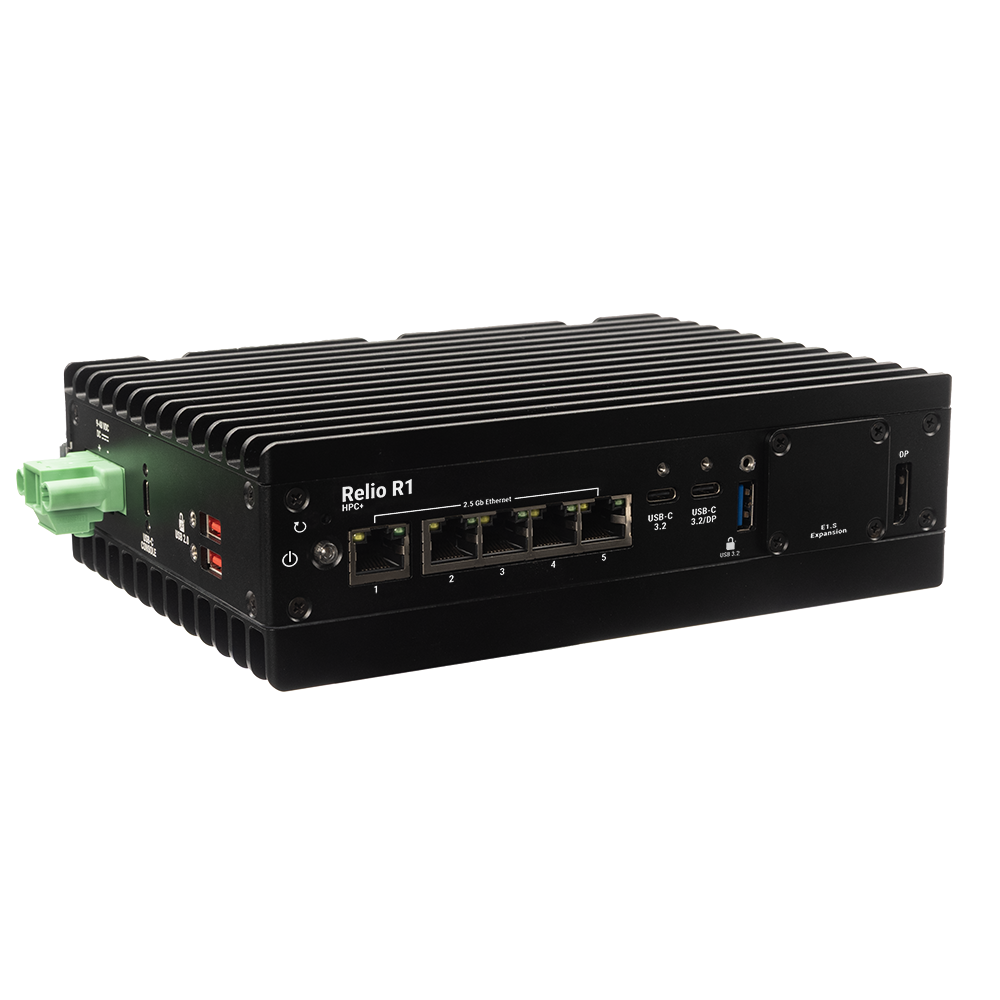 The Relio R1 HPC+ was developed for applications that combine AI, machine vision, industrial networking, and high-performance edge computing on a shared rugged platform. Configurable I/O, high-bandwidth networking, and available processor options allow engineering teams to match compute performance to workload requirements while supporting workload consolidation in demanding industrial applications. Rather than forcing applications to adapt to fixed hardware, the platform is designed to support the architectural decisions that successful workload consolidation requires.
Ultimately, workload consolidation isn't measured by how many dedicated computers disappear from the control cabinet. It's measured by whether the architecture remains understandable as new capabilities are introduced, maintainable as software evolves, and predictable in demanding environments throughout the system's lifecycle. Those outcomes are the product of thoughtful system design, not simply more powerful hardware.
Frequently Asked Questions
What is workload consolidation in industrial automation?
Workload consolidation is an architectural approach that allows related applications, such as control, HMI, AI vision, diagnostics, and networking, to run on a shared embedded computing platform while remaining isolated according to their operational requirements. The objective is to simplify system architecture without compromising performance, reliability, or lifecycle support.
What are the benefits of workload consolidation?
Workload consolidation can reduce hardware, cabling, and integration complexity while improving resource utilization and long-term maintainability. Organizing workloads around their operational requirements instead of dedicated hardware also helps engineering teams validate, update, and expand industrial systems more efficiently throughout their lifecycle.
How do engineers determine whether workloads can share the same platform?
Engineers begin by evaluating workload behavior rather than processor specifications. Workload mapping identifies timing requirements, resource demands, communication needs, and I/O ownership to determine which workloads can safely share computing resources while maintaining predictable system behavior.
What should engineers consider before consolidating workloads?
Engineers should evaluate workload ownership, resource allocation, communication paths, I/O requirements, and system behavior under realistic operating conditions to ensure the architecture remains predictable throughout deployment and future updates.
Categories: